





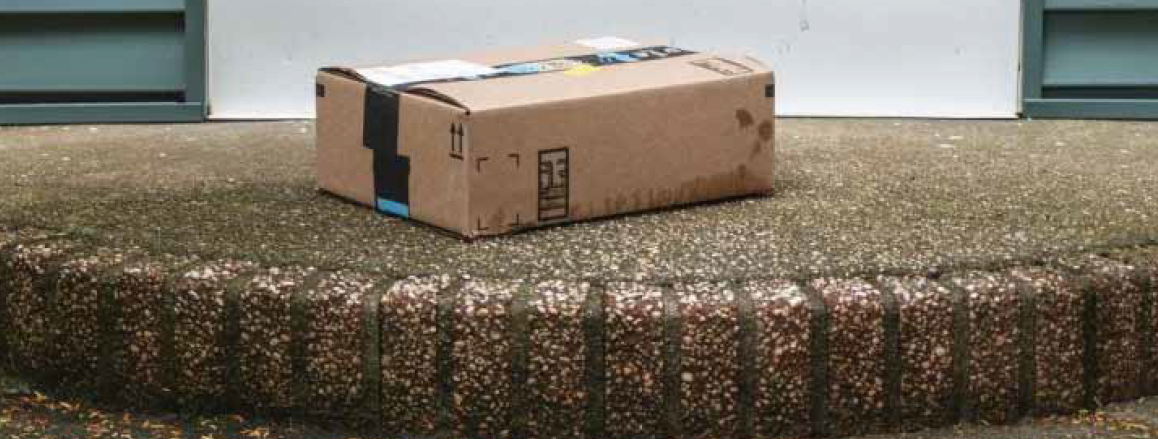
An Ordinary Corrugated Box. A Complex Business
On the hidden complexity of the corrugated business, the value still locked inside a plant, and what it takes to turn change into results
From the outside, corrugated packaging looks simple enough. Most supermarket shoppers barely notice it. But if a parcel arrives from an online marketplace and you are more interested in the box than in what is inside — or if your partner calls across the shop, "Stop touching and smelling every box!" — then you have truly caught the corrugated bug. Welcome to the club. It rarely lets go.
Konstantin, how did you fall for corrugated packaging?
■ I did not take the direct route into corrugated. I started in 2004, selling offset-printed folding boxes. The range also included litho-laminated packaging, where an offset-printed sheet is laminated to corrugated board to give the finished pack more strength. I soon saw real potential in Bag-in-Box and premium gift packaging. Within a year, one order could fill two weeks of capacity on the laminating line.
That was more than twenty years ago. Why did you stay in the industry, and what still fascinates you about it?
■ Many people have no idea how deep the rabbit hole goes. When I was already running a corrugated plant, I interviewed a young and ambitious candidate for a production-planning role. He told me he liked analytics and working with large data sets. Then he looked at our business and said, "You make ordinary boxes here. How much depth can there be? Where would I use my analytical skills?"
We made a deal: if he did not find enough complexity, analytical challenge or data during his probation, he would receive one month's compensation. A month later, he was asking for extra training — and from time to time his brain was already overheating.
The magic of corrugated packaging lies exactly there: an extraordinary number of details and decisions sit behind the ordinary box that finally appears on a supermarket shelf.
How did that practical industry experience grow into the idea for Open-Flute Consulting?
■ Actually, the idea found me. Someone I knew came to me with a very specific problem: selecting production-planning software that could fit into the plant's existing system landscape, including several applications developed specifically for that plant. We agreed what the project had to achieve, and I took it on. When the third enquiry came in — from a third client — the pattern was hard to ignore. These were no longer isolated consulting jobs; they were becoming a business. That was when I had to think about a company name and what the new company should become.
The corrugated industry is more than a hundred years old. If everything important has already been invented, where can plants still find room to grow?
■ Generations of controllers come and go, but the foundations of many processes remain the same. Yet in a mature industry, performance is often won or lost in the details. Corrugated is no longer a blue ocean with sky-high margins. There is rarely one dramatic breakthrough. Progress comes from many small, focused improvements that reinforce one another.
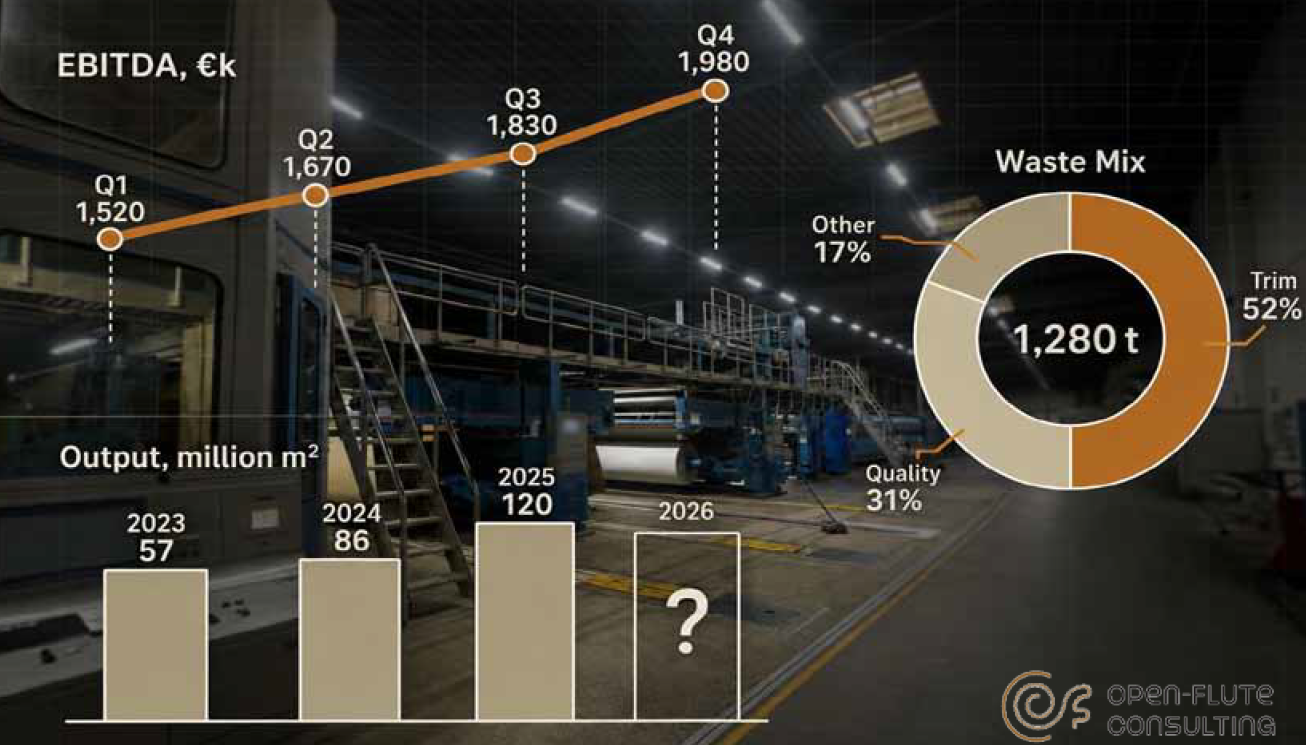
An expert's first task is to identify and quantify where value is being lost. The cause may be excessive side trim or an inefficient packing and palletising scheme that drives up transport costs.
Defect reduction can justify a project of its own. You need to understand why defects occur, what they really cost, and how customer claims are handled. In some plants, poor information flow slows the sales process; digitising hand-offs between departments can free commercial teams from avoidable administration. Elsewhere, the money is buried in downtime data and root causes that have never been analysed properly. And sometimes the issue is neither machinery nor software, but the way responsibilities, workload and headcount are arranged.
Finding an opportunity is only half the job. The harder half is converting it into margin without destabilising the rest of the plant. After all, the only plant with zero waste is the one producing nothing.
So is corrugated less about one brilliant idea and more about daily discipline?
■ Exactly. And the value of that discipline is very tangible: in a medium-sized plant, one extra percentage point of annual gross margin can be worth hundreds of thousands of euros.
What brings companies to Open-Flute, and how do you decide where to begin?
■ No two assignments have looked the same. Real plants are always more complicated than a service list. One route is a broad diagnostic review of business processes, management accounting, basic financial reporting and production waste. We then turn the findings into a map of improvement priorities, with targets measured in tonnes, square metres and euros. The other route is for a company that already knows where the pain is. In that case, we define a focused project that fits the plant's current stage of development.
There is no 'correct' project size. It may be a sales KPI matrix, or it may be the business plan for a green-field corrugated plant.
A director's order will not stop a corrugator from producing defects. Each problem needs the right mix of tools and resources: automation, digitalisation, process redesign, staff training — and usually more than one of them.
My involvement does not end with a recommendation. I also take part in implementation and stay with the plant while the new way of working takes hold.
ERP, MES and CRM implementation support is one of Open-Flute's services. Why can't an operating plant treat such a project as a simple software installation?
■ Every plant reaches digitalisation from a different starting point. Some begin while the corrugator is being commissioned; others wait until the business has reached break-even.
Some digitise the full core work-flow — from pricing to finished-goods dispatch. Others build it module by module: first corrugator line-up, then production planning and shop-floor execution, and later CRM.
At a running plant, equipment is fully loaded and few managers would accept stopping shipments for more than a day. Implementation therefore becomes a cutover challenge as much as a software project. Users have to be trained, master data cleaned, and historical data migrated. The new platform must reflect actual plant capacity and process logic, fit the existing architecture, and exchange reliable data through APIs with financial-reporting systems and other business software. Before go-live, critical scenarios have to be tested and signed off by users. After cutover comes hypercare: fixing early defects, supporting users, and stabilising the new process until it works without the project team standing behind it.
For such projects, Open-Flute brings together a project manager, a business-process expert, an IT specialist and a testing specialist. Responsibilities are clearly divided, but the roles overlap enough for the team to challenge decisions and back one another up. We stay through go-live, until the new way of working is stable.
When should a manager or investor contact Open-Flute?
■ An investor is considering entering the corrugated industry and needs a market assessment, a feasibility study or a complete business plan.
A plant is being launched — or has only just started — and wants to get through the early months without avoidable mistakes and expensive experiments.
The corrugator is running, converting is on three shifts, yet the plant is still losing money.
Or a long-established plant has stable processes, but competitors are closing in and pushing prices down. That is when management needs to look for internal reserves and define its own path forward.
An owner is preparing a corrugated business for sale. Here, Open-Flute can identify the small number of operational and management changes most likely to improve the business's attractiveness to buyers and its valuation, without spending more time, money or management attention than necessary. We know what large strategic buyers value — and where they look first